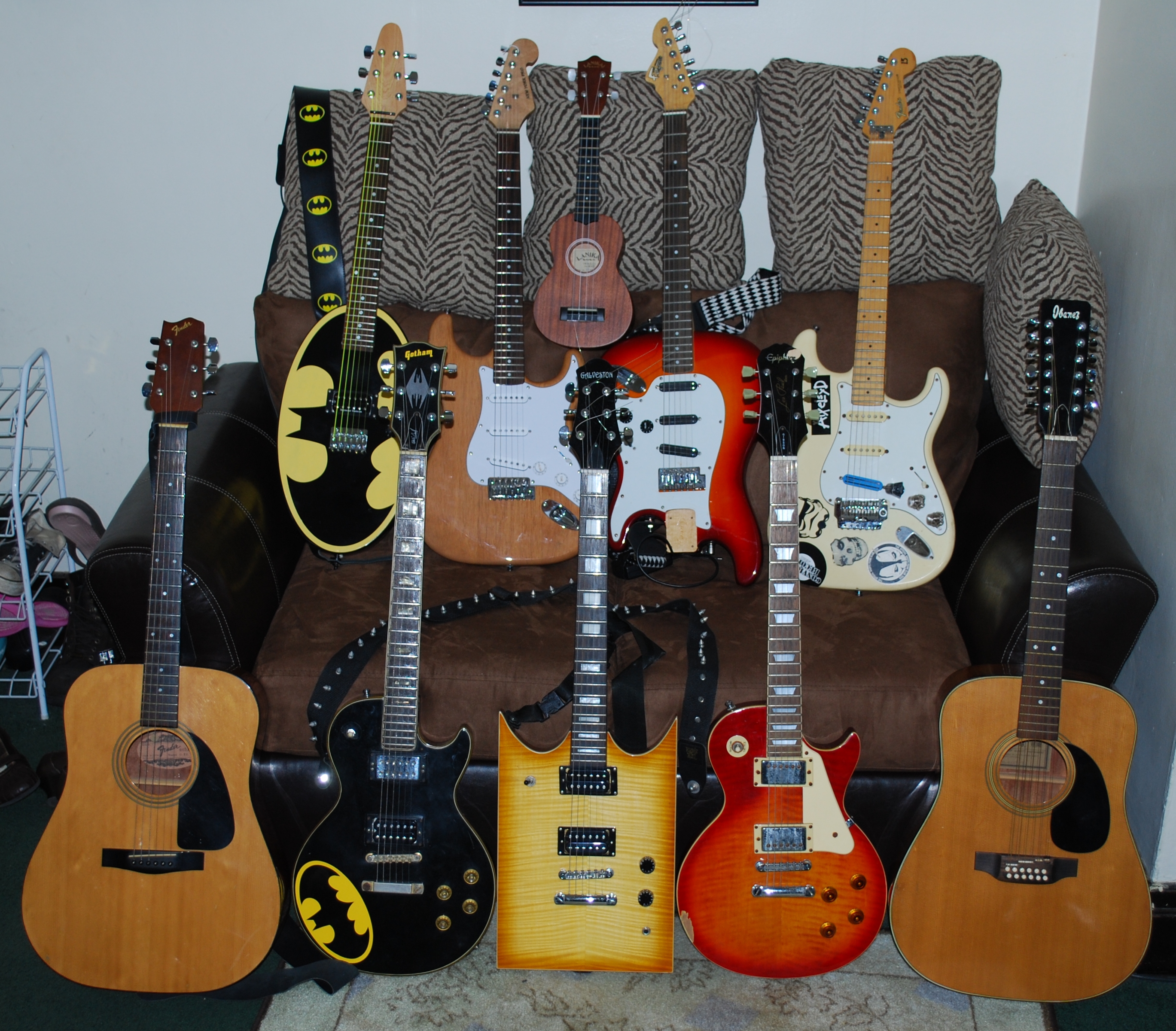
The Down & Dirty on the Galveston B.B. Stone.


You know I have a collection of weird guitars. I know I have a blog. Sometimes I blog about my weird guitars.

I’ve written about my Galveston B.B. Stone before, and again more recently, but really I’ve only ever nailed down the whole saga of the Eagle brand… Not the origin of this specific model. (Check the comments on those posts too, people have reached out!) So I went back to the well and reached out to Örjan Jacobsson & Jerker Antoni again, hoping to finally close out the top trilogy of my wild axes.
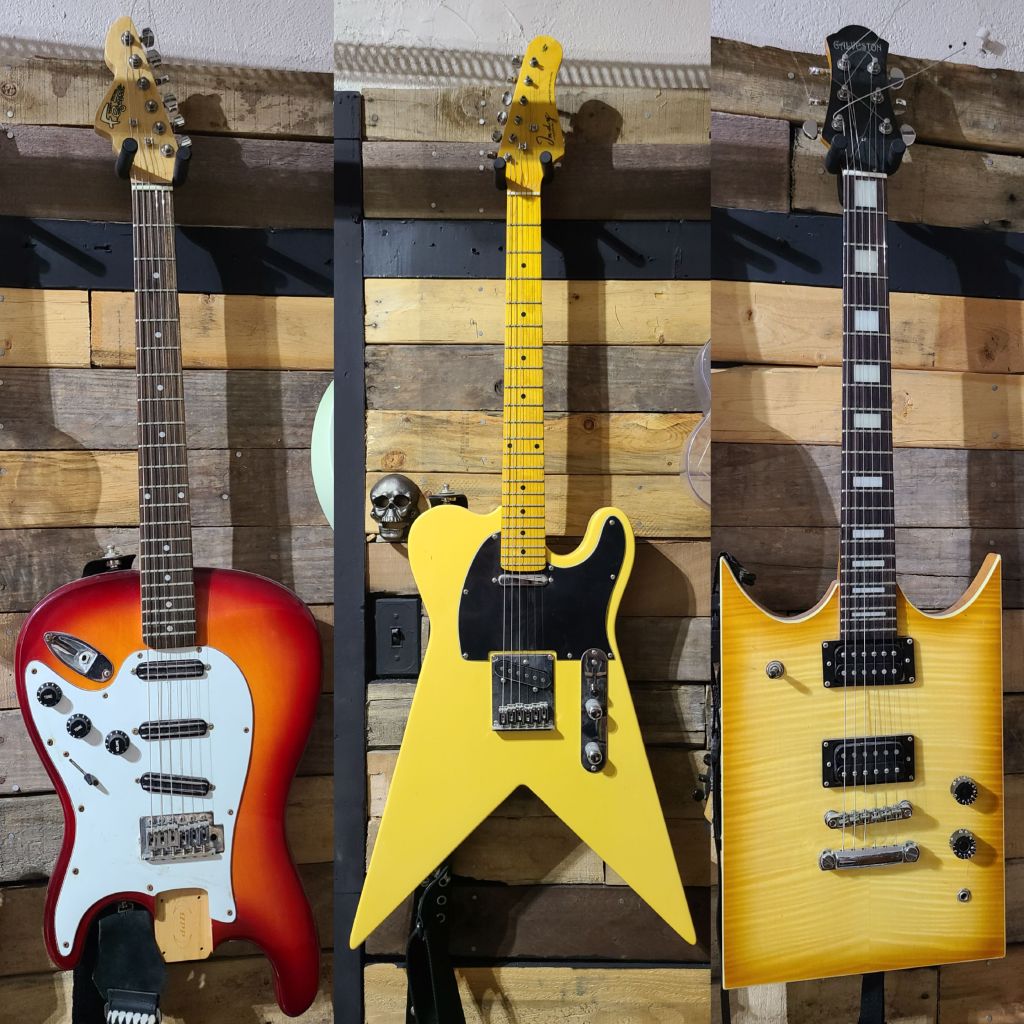
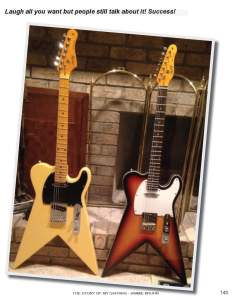
Dewey Decibel FlipOut: A vintage-style sunburst electric guitar featuring an inverted S-style body shape, a white multi-pickup guard equipped with three single-coil pickups, a standard tremolo bridge, control knobs clustered on the lower horn, and a maple neck with a dark fretboard and distinctive headstock shape.

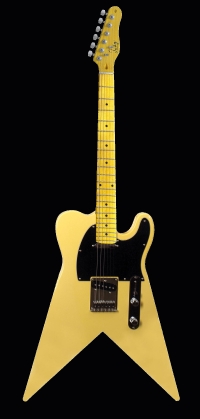
Indy Custom FlyCaster: A bright yellow electric guitar with a custom modified shape combining T-style elements and sharp V-style bottom points, featuring a solid yellow finish, a black pickguard, two single-coil pickups, a standard bridge, and a matching yellow maple neck and fretboard with a pointed headstock.

Galveston B.B. Stone: A honey-burst, flamed-top electric guitar boasting an aggressive, angular dual-cutaway body shape, a bound fretboard with large block inlays, dual black humbucker pickups, a Tune-o-matic style bridge with a stopbar tailpiece, control knobs placed along the lower right edge, and a dark headstock bearing the Galveston logo.

🎶

I’ve already gotten some nice seriously in-depth info about the process of creation from the makers of the Dewey Decibel FlipOut and the Indy Custom FlyCaster. I even drew the FlyCaster into one of the maze designs available in my second book and on merch, like this shirt.

I needed to get to the bottom of the impetus of the B.B. Stone once and for all.

I consider these three my twisted trio. I’ll reach for one of these or my New York Pro Star Gazer before anything else, typically.

I reached out to Örjan & Jerker once again to try and get the inspiration behind the square guitar shape.

Örjan’s reply was short & sweet:

Contact my partner [______]@gmail.com. He was the designer of that model.

Hälsningar Örjan Jacobsson

Which, fair enough, tracks with everything he’s told me before.
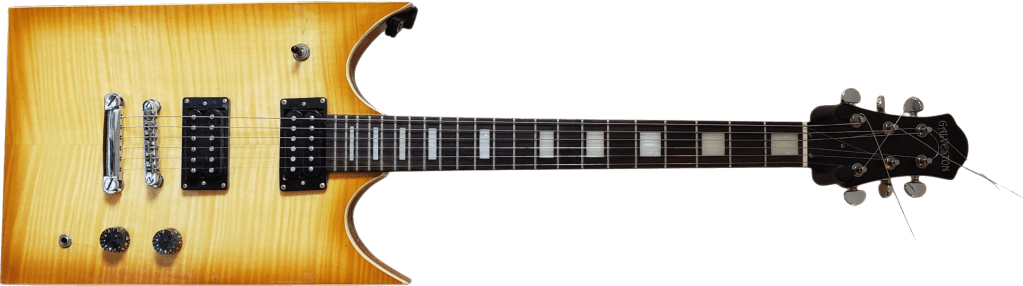
Galveston B.B. Stone (Horizontal View): A horizontal studio product shot of the honey-burst, flamed-top electric guitar, featuring its distinctive angular dual-cutaway body layout, dual black humbucker pickups, Tune-o-matic style bridge with stopbar tailpiece, bound fretboard with large white block inlays, and the black headstock with the Galveston logo set against a clean black background.

Jerker sent over a chunk of his memoir, A Music Dealer’s Confessions, written in 2020, and it rules. Here’s the part that pertains to the B.B. Stone, straight from the source:

Eagle Instruments

JAM had the agency for very good sound cards from Korea in the late 90s. And when JAM was no longer allowed to buy Gibson and Epiphone from Luthman due to pressure from, among others, Estrad and others, Örjan and I started a new guitar brand, Eagle Instruments. I found a nice eagle online and fixed the logo that would be on the head and we also designed the shape of the head itself. The eagle I stole was actually a variant of Iraq’s state emblem. Haha!

During the Musikmesse in Frankfurt, Nysse and I got in touch with a very good guitar manufacturer in Korea called Unsung… We visited Unsung’s factory, which was located in Inchon, a port city not far from Seoul. The guy who was the sales manager, we became very good friends with during the Musikmesse in Frankfurt. He had a strange Korean name that I tried to translate because all Chinese and Korean names seem to mean something. He explained that it meant big brave stone. So when we were brainstorming and trying to put it together in English, it became Big Brave Stone. I ended up thinking that he should change his name so that he wouldn’t have that typical Korean name on his business cards that no one remembered anyway. I suggested the name B.B. Stone, and that’s what it was. He still calls himself that — several years after he left Unsung and started his own company, which of course is also called B.B. Stone.

Jerker Antoni

So there’s your answer on the name, at least. Not a bluesman. Not a nickname for the shape. A Korean sales manager Jerker basically rebranded on the spot at a trade show.

There’s a lot more in what he sent, including warehouses full of unpaid-for Epiphone stock because Gibson stiffed the factory, a bass player named Hazze Wazeen who used to end shows by launching his bass into the air, decibel police getting talked into letting the volume slide, a Sam Ash rep getting told off mid-pitch by Hazze himself. It’s a fun read and super inside-baseball to the industry.

I asked Jerker point blank: What was the inspiration for the B.B. Stone’s shape design, the squared-off body with the deep double-sharp cutaways? Buddy Guy meets Van Halen? This is the one that started my whole weird-guitar obsession… I need to know. Right?

His answer:

I dont really remember – just wanted it to stick out! Like my Penis guitar!

Jerker Antoni
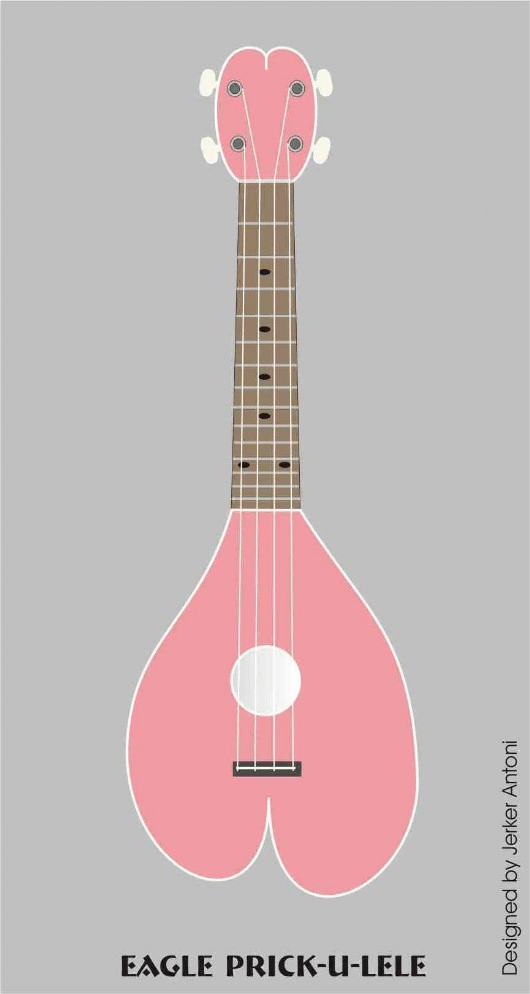
Graphic illustration of a light pink, heart-shaped ukulele centered against a solid grey background. The instrument features a brown fretboard, four tuning pegs, and a round soundhole. The text at the bottom reads "EAGLE PRICK-U-LELE" and "Designed by Jerker Antoni" runs vertically along the right edge.

There it is, the whole story.

This is a guy whose first wild design was built as a novelty prop for Swedish rock legend Magnus Uggla’s live show. (See the video below.)

He also sent me pics of a coinpurse-bodied Eagle Prick-U-Lele, the Violele, and an Eagle Metal Vee. Talking all that in, I guess “I just wanted it to stick out” is the genuine answer. It’s bruh’s entire design philosophy in one sentence. It certainly grabbed my attention!

I didn’t get the deep origin story I went digging for, but I think I got something absolutely honest. It’s proof that the guy behind one of my favorite weird guitars genuinely does not design anything that isn’t weird. How can I not have mad respect for that?

Check out Jerker’s site at www.jerkerantoni.se and peep the memoir if you can read Swedish!
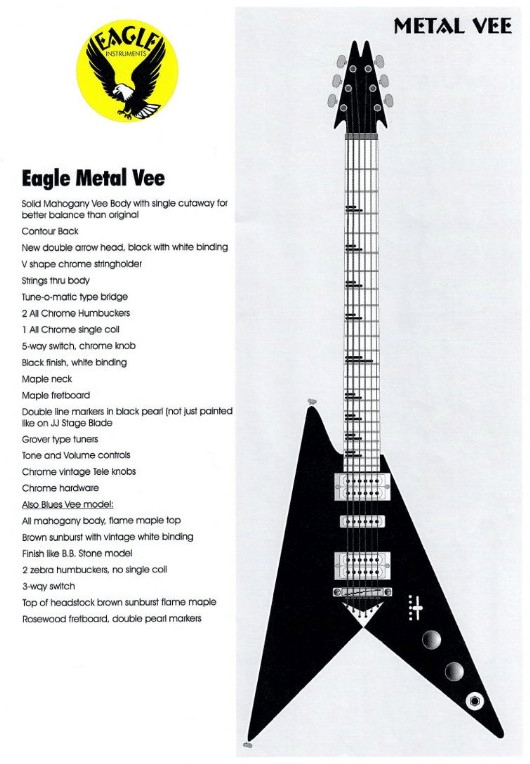
Eagle Metal Vee Specification Sheet: A product catalog page for the "Eagle Metal Vee" guitar, featuring a black-and-white illustration of the black Flying V-style electric guitar on the right, alongside the Eagle Instruments logo, model name, and a comprehensive list of technical specifications and features on the left.

Eagle Metal Vee

Solid Mahogany Vee Body with single cutaway for better balance than original
Contour Back
New double arrow head, black with white binding
V shape chrome stringholder
Strings thru body
Tune-o-matic type bridge
2 All Chrome Humbuckers
1 All Chrome single coil
5-way switch, chrome knob
Black finish, white binding
Maple neck
Maple fretboard
Double line markers in black pearl (not just painted like on JJ Stage Blade)
Grover type tuners
Tone and Volume controls
Chrome vintage Tele knobs
Chrome hardware

Also Blues Vee model:
All mahogany body, flame maple top
Brown sunburst with vintage white binding
Finish like B.B. Stone model
2 zebra humbuckers, no single coil
3-way switch
Top of headstock brown sunburst flame maple
Rosewood fretboard, double pearl markers

🎸

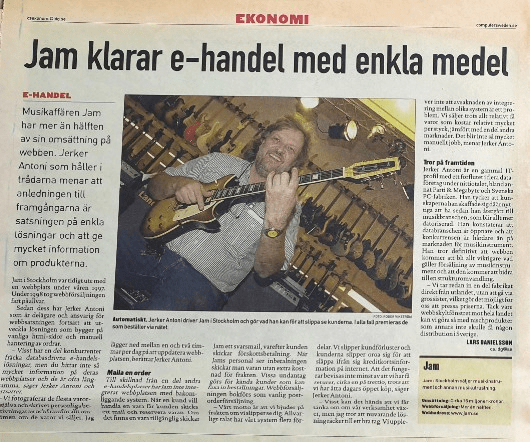
A newspaper clipping in Swedish with the headline "Jam klarar e-handel med enkla medel," featuring a photo of Jerker Antoni holding an electric guitar inside the Jam music store, surrounded by guitars on the wall.

Here is a translation of the main article text and key elements from the Swedish newspaper clipping:

Main Headline
Jam handles e-commerce with simple means

Section Header: E-COMMERCE
Music store Jam generates more than half of its sales on the web. Jerker Antoni, who pulls the strings, believes the secret to their success is investing in simple solutions and providing plenty of information about the products.

Body Text
Jam in Stockholm was early out with a website in the spring of 1997. In 1998, web sales really took off.

Since then, Jerker Antoni—who is a co-owner and responsible for web operations—has continued to develop solutions based on normal HTML pages and manual order handling.

– Some of our competitors have fancy database-driven e-commerce solutions, but you won't find as much information on their websites as on ours, says Jerker Antoni.

– We photograph most of the items we sell, rather than using manufacturer pictures, so the customer knows what we are selling. I spend between one and two hours a day updating the website, says Jerker Antoni.

Mail and Order
Unlike some other e-commerce sites that integrate their website with a back-end system, shopping with Jam involves sending an email and reserving the item. If the item is available, Jam sends a reply email, and the customer sends advance payment. When Jam's staff receives payment, they ship the goods at no extra shipping cost. For regular customers, goods are sometimes sent as regular mail-order sales.

– Our motto is that we are scared of anything that makes us lose personal contact. Honestly, our system solves parts of the integration between different systems as a problem. We sell everything relative to value that costs relatively a lot of manual work, says Jerker Antoni.

Belief in the Future
Jerker Antoni is an old IT profile with a past in several pioneering computer initiatives, including Partille Megabyte and Svenska PC-fabriken. He thinks that the computer industry has been slow to transition to e-commerce, which is becoming more computerized. He notes that the computer industry is open and competition is tougher there than in the music industry. He definitely believes that the web will become even more important when it comes to selling musical instruments and that this will drive structural change.

– We already source parts of our manufacturing directly from abroad, without going through wholesalers, which makes it possible for us to lower prices. Thanks to our web-based network, we can reach our products to the entire country, which would otherwise require two distributions in Sweden, says Lars Danielsson.

Box: Jam

Jam: Music store in Stockholm selling musical instruments and other music equipment.

Turnover: Roughly 15 million Swedish kronor.

Web sales: Roughly 8 million Swedish kronor.

Website: www.jam.se
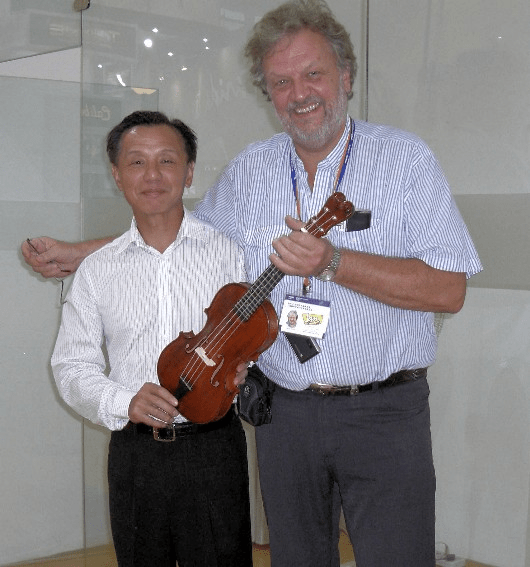
Jerker Antoni and Colleague with Violin-Shaped Ukulele: A candid photo of two men smiling together indoors, with the man on the right—Jerker Antoni—wearing a striped button-down shirt and holding a small, brown violin-shaped instrument or ukulele, with a conference badge hanging from a lanyard.

Oh yeah, can you guess which guitar he designed here?

Also check out the Jam store and Orjan’s site: https://www.oscarguitars.se/en/ (& Facebook Group)

I wonder what Jerker & Örjan would think about the Shitar and the Bat Logo Guitar? I bet they would love to have their rigs rated & roasted.

Do you have a B.B. Stone? How about any other Eagle or Galveston instruments? Hit me up in the comments about how you found yours!

The Galveston B.B. Stone


OK, so I already blogged about this one. You gotta peep the comments there, one from Orjan Jacobsson is very enlightening! I gave up SquareGuitar.com a log time ago, so all those links are broken, but as of now it still lives via the Wayback Machine.

I wanted to grab some of the info I gathered from there to drop here to go along with my Dewey Decibel FlipOut and Indy Custom FlyCaster posts, hell even the custom Russ Lorenz Shitar. Sorry if most of these links below are just broken or no longer exist. I like weird guitars and obsolete websites, I guess.

A composite photo showing different angles of a uniquely shaped, rectangular-bodied Galveston electric guitar with a sunburst flamed-maple top. The left panel shows the full instrument hanging, the top-right panel shows a close-up of the body and dual humbucker pickups, and the bottom-right panel shows a close-up of the black headstock with the Galveston logo.

The short of where it stands as I understand it now:

Jerker Antony & Orjan Jacobsson designed the guitar, had it manufactured at Un-Sung in Korea, sold it under the Eagle brand in Sweden/Scandinavia and in the U.S.A. under the Galveston brand… Maybe Brownsville too? I still don’t know anything about Galveston, or really Un-Sung. B.B. Stone was a nickname for a salesman, and he was not a player who got a signature. I can assume this was inspired by Bo Diddley’s square guitar meeting 80s flash? Maybe? I should reach back out to these guys and see if I can get some updated information. It seems there are 24 worldwide, and 12 made it here to the US? There there is an orange/butterscotch option and a black/ash one. The names Dae-yong Suk & Chess Lim have come up in searches too.

I’d love to find the owners of the rest of them out there in the wild. Please, share your stories and photos in the comments!

An image comparing two guitar headstocks side-by-side against a wooden background. The left panel shows a black Galveston headstock with strings, and the right panel shows a natural-wood Eagle headstock with a cutout center and three tuning pegs on each side. Blue text at the bottom reads: "The headstock is the main difference between the Galveston B.B. Stone model & Eagle B.B. Stone model."

The original synopsis from me (via SquareGuitar.com):

My band was playing show at the American Music Café, a venue in Murrysville Pennsylvania with an attached music store. The venue & music store would be described by many locals as a “shady” business place. We played there a lot because it was easy to book shows, & a lot of our fans & friends all seemed to gravitate to the place because of the growing (at the time) void of live all-ages music venues. Every once in a while a cool or strange guitar went through the store among the usual myriad of second-rate knock-offs. On Saturday December 23rd, 2000… I saw the “square guitar”, and bought it that day. I actually ended up trading in a Cimar by Ibanez Strat clone guitar that I had purchased earlier in the week in trade for it.

Trying to find out anything about the guitar manufacturers that use the Galveston brand can prove to be difficult. The best I can gather is that they’re made in a factory somewhere in Korea.

The model name is not listed anywhere on my guitar, & I didn’t know what it was until I came across a black & white photo on some discount guitar store’s website. I noticed that he headstock is quite different from my guitar though, and there was no visible name on the headstock of the pictured guitar, but I’m getting closer.

  • The first piece of useful information about the Galveston B.B. Stone that I came across was a review found at Harmony Central. Check it out here. – I don’t know if I agree with this guys ratings 100%, but he seems to have a lead on Galveston, Silverstar, and Un-Sung Musical Insruments… and what he’s equating it to as far as existing models. I haven’t been able to find anything out about Silverstar or Un-Sung Musical Instruments either, but if you have any information on any of the aforementioned companies, please let me know.
  • Through my searching, I did find two useful sites: Eagle Instruments & B.B. Stone & Son Musical Instruments. Eagle instruments apparently makes the exact same B.B. Stone Signature model, & they’re actually the originator. They give these Specifications.
  • From that website, I was able to discover & e-mail the actual designer of the guitar, Jerker Antoni. This is my correspondence with him, we were sightly confusing each other at the beginning. Maybe it has to do with the language barrier?
  • I sent the same e-mail to B.B. Stone himself, and got a little less of a reply. I think there was a slightly stonger language barrier here.
  • I can only see one major difference between the Galveston & Eagle models, the headstock. Also, the Eagle models appear to have the words “B.B. Stone” on them.
  • Know anything about this guitar? Where did you find it? Remember the day you bought it? Please share it with us!

My Emails from Jerker Antony:

—–Original Message—–
From: Jerker Antoni
To: ERiC AiXeLsyD
Sent: 7/8/2004 11:54 AM
Subject: SV: Mail från hemsidan (Galveston B.B. Stone?)

OK – now I understand what model it is – it is the B.B. Stone model, not
the Flash B.B. model.
In Scandinavia we used the Eagle head as you can see on attached
picture. We sold just 24 pcs all in all world wide I think.

I designed it (like I told you about the Flash B.B.) – but this model
was designed totally from scratch, and not like the other models with
the B.B. names like Flash B.B. aso.
Still with indonesian mahogany body and canadian hard rock maple neck.
It was never imported by Sam Ash or anybody else from what I know, I
think there are just 8 or 12 pcs in the USA and all imported by
Galveston.
Thanks for the pictures, I might put one up on our hompage later and
link to your homepage if that is OK.
Take care!


—–Ursprungligt meddelande—–
Från: ERiC AiXeLsyD
Skickat: den 7 juli 2004 23:44
Till: ‘Jerker Antoni‘
Kopia: ‘eric@aixelsyd.com‘
Ämne: RE: Mail från hemsidan (Galveston B.B. Stone?)


Wow Jerker,

You don’t know how long I’ve been searching for the origins of my
guitar! Here’s a picture of my collection:


When my band plays out though, people always ask to see the “square
guitar”, ha ha ha. It’s what I use on stage mostly. I love the feel of
the fretboard, and I love the sound. It does have great sustain, &
someday I might replace the pickups with something a little screamier…
but for now, I love what I’ve got. I’m assuming it was made in Korea &
it’s from a small run. It’s next to impossible to find anything out
about the company Galveston, but it looks like I somehow surpassed them
& got right to the source!

I don’t know how I can thank you enough for the explanation, or for the
great guitar design. I will tell you to keep up the great work, & link
you to some photographs of me with the guitar in action:


You’re my hero, dude!


Rock on!
-Eric Carroll a.k.a. ERiC AiXeLsyD – www.aixelsyd.com

—–Original Message—–
From: Jerker Antoni 
Sent: Wednesday, July 07, 2004 2:47 PM
To: ERiC AiXeLsyD
Subject: SV: Mail från hemsidan (Galveston B.B. Stone?)

Dear Eric,
I designed that model. It is a great guitar, light and easy and with
better sustain than most Les Pauls, as the body is from indonesian light
mahogany, and the neck is not from mahogany but from hard rock canadian
maple. Pickups are OK for korean made, but that is easy to change if you
want.
They got so popular here that Gibson sent their lawyers to sue us, they
thought it was a copy of their LP model but they just had the picture,
and they did not see the backside of the instrument with the body shape
going through the neck like an S-curve. So I took a picture of the
backside and they gave that thing up.
We called it Eagla Flash LP as all models I designed with star inlays in
the fretboard were called Flash something, but Gibsons lawyers thought
LP stood for Les Paul so they were still angry.
So we changed the name to Flash B.B. as B.B. Stone was the boss of the
factory that produce them, Un Sung in Inchon, Korea, south of Seoul.
The B.B. Stone name is another story, his korean name was very odd, so I
asked him to interprete it in english, and it meant Big Brave Stone, so
I thought he would be better remembered as B.B. Stone. So he changed his
name and he also put up his own company later on using this name.
We sold a few hundred of this model in Sweden, and also a few hundred in
the USA, some to Sam Ash (they used the Brownsville logo for their own
imports), and some to other importers like the guys with the Galveston
logo.
They all use other headstocks, we had our own Eagle headstock which I
think looks better.
Later on we made other versions of it like the Mezz signature model, the
same instrument but with oil finish for even better sound. The guy Mezz
is a great guitar player and singer, american that lives in Europe.
His father was jazz musician Mezz Mezzrow, who wrote a classic jazz book
in the 50’s.
Take care of the guitar – it is really a great instrument – especially
compared to the Gibson models which I think are great looking junk for
the guys that were not allowed to play with doys when they were young,
so now they compare the looks of the birds maple tops of their Les
Pauls…
Best regards

Jerker

—–Ursprungligt meddelande—–
Från: ERiC AiXeLsyD
Skickat: den 7 juli 2004 20:07
Till: ‘eagle@eagleinstruments.nu‘
Ämne: Mail från hemsidan (Galveston B.B. Stone?)

Hello,

I found your sites at www.bbstone.co.kr & www.eagleinstruments.nu and
I was wondering if you knew anything about the Galvestion B.B. Stone
model guitar? I belive that I own one, only it does not have the B.B.
Stone logo, or the correct headstock… I cannot find any history on
Galveston or the guitar itself. I was wondering if you could possibly
help me out?


Thank you,
-Eric

My Email from B.B. Stone:

—–Original Message—–
From: BB.Stone
To: ERiC AiXeLsyD
Sent: 7/10/2004 11:38 AM
Subject: RE: Galveston B.B. Stone Model Guitar?Dear Eric

I have developed “BB.Stone” guitar before I established my own company.
At that time, Galveston purchased guitars. I am now selling various
kinds of musical instruments and guitar parts. I hope this will help
your questions.


Best Regards.


BB

Insight from Orjan Jacobsson:

Orjan Jacobsson's avatarOrjan Jacobsson

 says:

Edit

Hello I was one of the owners of Eagle Instruments AB Sweden. Jerker Antoni and I Orjan Jacobsson. This guitar was designed by Jerker that´s right. We made about 12-18 pcs of it under our brand Eagle. Since there are too many Eagle branded products out there we could not use that name in other countries than Sweden. Other companies like Galveston bought guitars under their own labels to sell. Some of them through Sam Ash under the brand Brownsville. Made by Un Sung in Inchon Korea.
BB Stone is no blues guy from Korea. He was the salesman at Un Sung. Hes name was something like Dae Young Suk. That did not sound so good Jerker thought. He asked him to translate this korean name into English. He said it means “Big Brave Stone” Hence that: BB Stone. So Jerker named him that. Today he uses this on his buisness card. He has his own Company today and don´t work for Un Sung. Funny story isn´t it?

A composite image showing three electric guitars mounted side-by-side on a rustic wooden plank wall. From left to right: A Dewey Decibel FlipOut, a sunburst double-cutaway guitar with a white pickguard, The Indy Custom FlyCaster a bright yellow V-shaped-bottom guitar with a black pickguard and a matching yellow neck, and the yellow sunburst flamed-maple Galveston BB Stone guitar with a rectangular body.

The story of the Dewey Decibel FlipOut guitar.


Bert - a.k.a. ERiC AiXeLsyD - rocking the Dewey Decibel FlipOut Lit Cigarette model.
Bert – a.k.a. ERiC AiXeLsyD – rocking the Dewey Decibel FlipOut Lit Cigarette model.

OK. So, you probably know I like weird guitars. Someday I will have profiles up of all of them on another blog. You may have even read about my Dewey Decibel FlipOut before, or have seen the FlipOut before (or even the knock-off Flipped brand). While the Galveston BB Stone certainly started my weird guitar obsession, the FlipOut solidified it. Sadly, I came to it after AiXeLsyD had been done for a while, and I think even after Gasoline Dion. It some incredibly small and ancient circles I will always be known as ERiC AiXeLsyD. I did, get to gig out with the FlipOut, quite a lot, with Ernie and the Berts.

A while back, I had the opportunity to reach out to Jimmie Bruhn about the Indy Custom Flycaster, and way way back I did some research on the BB Stone. (I have to try to recover all the stuff that used to live on SquareGuitar.com, all those links are now dead.)

I thought it would be fun to try and track down Dewey Decibel (a.k.a. Joe Jerardi – or is it Joe Geradri? Stage names are fun.), and get some insight on the inception and production of one of my favorite axes!

After some emails exchanged, here’s the story from the man himself!

Line of FlipOut guitars & BottomOut basses from the Dewey Decibel website.

Hi Eric,

I’m awfully sorry there was a delay on getting back to you.  I honestly have had my hands full this year, and it slipped my mind.  Just for your patience, I can offer the most information I’ve shared about my FlipOut days to this point.  And thanks for asking.

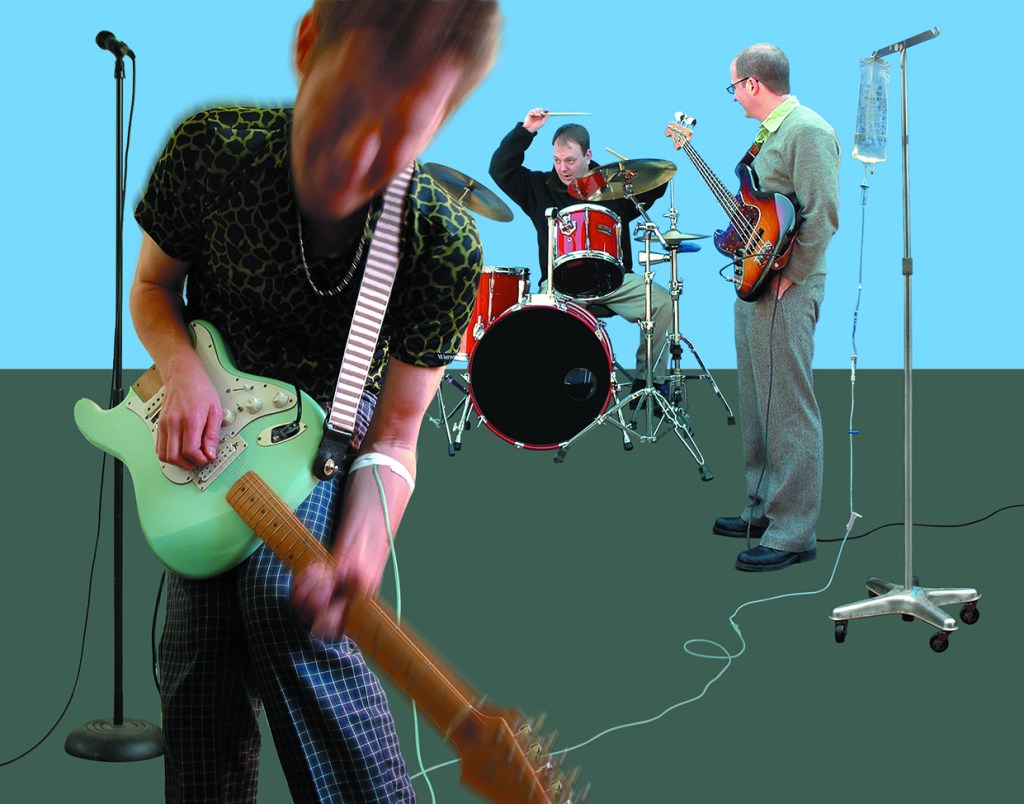
I was performing solo in NY back in the 90s, playing CBGBs and many of the NY clubs. My stage name was Dewey Decibel, and I always performed hooked up to an IV pole.  Just a thing I did – never mentioned it on stage.  Played electric guitar, with synth sequencers for backing, plus voice. 

One day I thought of this backward guitar – Its just wood I thought – so it would play the same, just super unsettling, and deeply rock and roll to my mind.  I found one shop out of all the NY guitar techs who would follow my instruction. It was Rick from Carmine Street Guitars.  I love him because he didn’t even blink, just said “sure, I can do that”.  I went on to form a band called… Dewey Decibel, and kept doing shows, and finished up my third album “Unnecessarily Beautiful” with those guys, great players Jon Howard, and Martin Miller.  We did good work.  I always played the original FlipOut, which started its life as a Fernandes brand Strat.  I always had the IV drip by my side.

Back cover for the Dewey Decibel album Unnecessarily Beautiful | Original FlipOut prototype of a modified Fernandes Strat copy pictured!

We did no real promotion for the album, for any of my albums, so they reside in resplendent obscurity, rarely to surface.

Here is what exists online, though there are 3+ albums and an EP somewhere:

https://deweydecibel.bandcamp.com/

Dewey Decibel | Unnecessarily Beautiful | Pictured: Martin Miller (Drums) ● Dewey Decibel (Guitar & Vocals) ● John Howard (Bass)
Dewey Decibel | Unnecessarily Beautiful | Pictured: Martin Miller (Drums) ● Dewey Decibel (Voice/Guitar/Keys) ● John Howard (Bass)

At shows, my guitar got so much crazy attention I conceived of the nutty plan to use a release of these guitars to bring attention to my band.  In 2003 I went to the NAMM show on the recommendation of a friend, to look for a manufacturer.  There I approached many confused factory reps from Asia, and ended up having luck with a Korean group who were ready to please.  I ordered some prototypes during that year, and tweaked things.  Then at 2004 NAMM I introduced them to the unsuspecting earthlings, took orders, and started shipping out of San Francisco once the container ship arrived.  That first NAMM show was funny funny stupid funny. 

Dewey Decibel - FlipOut & BottomOut
Art from the Dewey Decibel website.

The stupid part was that Fender lawyers sent me a letter on the opening day of my NAMM  launch that I was in breach of their trademarks.  This is a much longer story but I ended up licensing with Fender later, which was great for name dropping and demonstrating to folks that it was a quality guitar.

I was living in a warehouse with boxes of these guitars and my drum set.  It was a time of odd existence, taking orders, shipping, doing R&D, and lining up reviews with the big guitar magazines.  The FlipOut got strong thumbs up reviews in Guitar Player as well as Guitar One.  I did care about the feel of the neck and the pickups.  It’s self evident I think when you handle one.

I was moving forward on the BottomOut bass, having received a few prototypes which worked nicely.  Even took orders.  The problem was that the whole business had me working in too many directions, and exhausted.  I’d gone to Europe, and did a bunch of sales, there and in Australia too.  I was overworking, and getting wiped out.  This was all on my own, and I’d been living with some fantasy that these cool guitars would elevate the music, and demonstrate my sovereign rock and roll whimsy.   But alas, the FlipOut project ended at around 500 guitars because I was exhausted, the R&D was too slow, and I couldn’t parlay the thing into working for another manufacturer.  I was too much of a lone wolf for them.  So I went back to graphic design and animation.  I’m an animator today living in incredible San Antonio. I also continue writing and recording a new album, to be released secretly into thrift store bins.

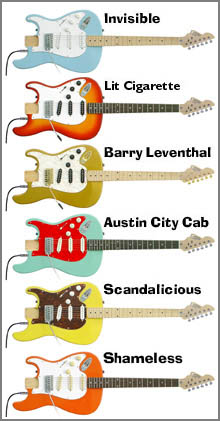
The guitar colors were just my favorites at the time, the names were inspired by memories. Barry Leventhal was I think a kid I played in little league with.  Austin really had cabs colored like the guitar.

I’ve seen the FlipOut rip-offs coming from Europe/China, and they look ridiculous, all backward and stuff.  Just joking – I guess it was inevitable someone would cash in.

Hey thanks for your interest.  Hoping it fills in some detail. 

Thanks

joe

For the Raging Guitar Houdini in you!

(ddB)™

What led Dewey Decibel, Brooklyn's recording enigma, to do what he did to his guitar that night? Frustration. His friends had snubbed him, his car had been totaled, but worst of all, his reading comprehension was way down, and he could feel the stares when he entered a room. That fateful night, Dewey did grab for his guitar, slamming his bedroom door, not to emerge for countless weeks (though he did leave once to go to a class on "Appalachian Fingertip Dancing"). It was during these weeks, through a period of painstaking research, made even more difficult by an ill-fitting lab coat, Dewey did travel to the edge of insanity. But once there, decided he'd rather be at the brink of madness, so he quickly switched when no one was looking. And when at last he did emerge, witnesses reported he held in his hand something resembling a guitar on muscle relaxant. Dewey Decibel's FlipOut™ was in their midst. And now, it is in yours.

www.flipoutguitar.com Write to us at flipout@deweydecibel.com

The guitar design configuration of Dewey Decbel's Flip Out™ is a trademark owned by Joe Gerardi of Dewey Decibel Inc. Any replication of this trademark is prohibited by law.

Dewey Decibel
Until now, this is pretty much all that was out there on the FlipOut!
Dewy Decibel FlipOut models | Invisible, Lit Cigarette, Barry Levelthal, Austin City Cab, Scandalicious, Shameless.
FlipOut models & colors

How cool is that? The entire story from the man himself! I urge you to go check out the music of Dewey Decibel.

The only mods I had done to mine is the inimitable Aaron Hutzel drop in some GFS Lil Killer rails. This was not a kock at all to the original sound, but the humbuckers are more my thing.

Check out the Facebook fan page if you’re a fan, would like to share photos of yours or you with it in action, have one for sale, or are looking for one: Facebook | Dewey Decibel FlipOut

I would also, of course, love to hear from you in the comments!

If you want to see me and my FlipOut in action, check out the stuff below this list of links.

Also, check out these links if you’re looking for more:

Ernie and the Berts “Toybox”:

Ernie and the Berts – “Everybody Poops”:

Ernie and the Berts – “Kate Winslett” (A poor cover of The Silver Brazilians):

Ernie and the Berts – “Ikea”:

Me just rocking this one in the basement in 2016:

An Interview With the Mad Mastermind Behind the Indy Custom FlyCaster


The Indy Custom FlyCaster

My Indy Custom FlyCaster

If you’re a regular reader, you know I recently posted all my guitars.  You would then also know that I like weird guitars.  You may have even seen me in a guitar-related Facebook group defending this beauty of an axe.  What is not to love?  The thing is fantastic.  It is a sight to behold.  It probably shouldn’t even exist, but it does an I needed to have it.

Mine is serial number 059.  I have even connected with a few other owners out there via a Facebook Fan Page.  I had expected to swap out pickups and drop in some rails… but, man this thing sounds beautiful.  The neck feels great.  It hangs well when standing.  It is just a great damn guitar.

I would say it is probably in my trifecta of ire along with the Dewey Decibel FlipOut and the Galveston B.B. Stone.  I have had people at shows come up just to tell me that they hate them!  Ha ha.  It amazes me that a music genre predicated on the idea of just pissing off the previous generation has so many purists who must adhere to some sort of imaginary rules of guitar design. and tired traditions.  It would be a fascinating sociological study to see exactly how that can be.  It’s OK to enjoy the classics and get a little wild sometimes.

Of course, many people get the joke and love them too.

In with posting All My Axes (did you see parts 1 & 2?), I really got to wanting to dive deep into the story behind each of these if I could.  The creator of the FLyCaster, Jimmie Bruhn was easy to find online, and seems like a great guy.  I would even say he found me in an “ugly guitars” group or two.  Check out my questions for him and his fantastic answers below my embedded Instagram Post of the FlyCaster.  The interview was conducted via the highly professional Facebook Messenger.


–🤘–

AiXeLsyD13: Who is Indiana Custom Guitars?

Jimmie Bruhn: There was no Indiana Custom Guitars. Indy Custom was that particular brand. Its actually a much bigger thing… SHS International was the parent company. It was an international music wholesale company that distributed products to music stores. Its where music stores nationwide (and globally) got a lot of their stuff. We designed, imported and sold products. Here are some of the following brands of SHS International (this is not the full list but the highlights)

Morgan Monroe Bluegrass Instruments
Eddy Finn Ukulele Company
Indiana Guitar Company
Indy Custom Guitars
ModTone Guitar Effects
Bean Blossom Instruments
Tune Tech Tuners
SHS Audio
Devlin Guitars
College Guitar Company
Sundown Amplifiers

I worked as a media producer for the company for close to 30 years and my fingerprints were on most everything from every brand. I wore many many different hats and guitar design was a tiny part of it. Fun but it wasn’t the bulk of what I did. That’s a whole other story. Suffice to say, anything you saw from any of those brands, I had a major role in bringing to life.

In addition I’ve played professionally for a long long time. I’m a writer, singer and I play a lot of different instruments. Guitar is one part of it but probably the biggest part as I am a lifelong collector and nerd. The collection is out of hand but I simply can’t help myself. I still have my first guitar. I never get rid of anything! You can hear and see my work on YouTube. Oh…one other thing…if you ever see Indy Custom Relic guitars, that was me. A one man side business I started where I produced over 400 hand relic’ed guitars. In that time I still played all the time, traveled and played all over.

Ⓐ⑬: Do they have a website?

JB: Not any more.

Ⓐ⑬: Do you have a website you’d like me to link to?

JB: https://www.youtube.com/channel/UC36We-7C4ghOW5tlsG0G-tQ (Jimmie Bruhn’s Jam TV!) This is a place for my various artistic ideas. A little of this, a little of that…you never know what you’re going to get.

Ⓐ⑬: How did you come to be a guitar designer? Have you designed any other guitars?

JB: I’ve been collecting guitars for over 40 years. It was natural that my need to build and tinker with stuff would spill over into my professional day gig.
Yes, I designed many guitars and would then send my renderings to the factory for prototypes and then on to a bigger run of them. When I say “designed” I in no way want to make it seem that I am some schooled luthier or anything of the sort. I just came up with designs and through trial and error, we would arrive at something unique but I wasn’t in a workshop running a saw!

Ⓐ⑬: How was the Indy Custom label to be different?

JB: By trying to get the best things we all liked about particular models into an affordable recreation that was a Big Bang for the buck. There were some really cool models that came out. I can’t say exactly how many but there were lots of designs over the life of that line.

Ⓐ⑬: I know you were in part inspired by the Zakk Wylde guitars with an SG top & a V bottom… did anything else go into it?

JB: Yes, comedy. It just made me laugh. Another thing that REALLY inspired it were people around the company who were genuinely disgusted by it. That made me want to get them produced even more. Yes, it was stupid, yes it was hideous but I knew it could get a lot of attention for the rest of the line. The powers that be couldn’t see the value in that but here we are all these years later still talking about it. ZERO advertising dollars spent. I wasn’t wrong!

Ⓐ⑬: Was it a hard sell getting in into production? (Convincing everyone else at the company/factory to go with it?)

JB: Some understood. Some did not. The ones that didn’t inspired me to push that much harder. The point was, good or bad…it was getting a major reaction. The only bad press is no press.

Ⓐ⑬: Where was it manufactured?

JB: These were all manufactured in China once final prototypes were approved.

Ⓐ⑬: Were there any issues with manufacturing? (Seems like a big body to be on a manufacturing line.)

JB: There are always issues in manufacturing especially trying to do it from thousands of miles away. Visiting the factories can keep quality control in check but ultimately once production starts things can go wrong. Not always, but that potential is there. Overall, there were no problems in the Flycaster. Even my Chinese contact remarked that the guys on the factory floor thought it was “a weird guitar” which meant even a cultural and language barrier cannot deny that The Flycaster is globally offensive!

Ⓐ⑬: Why “FlyCaster?” Everyone who sees it calls it a TV or a Tele-V. Ha ha. Was that by design?

JB: Because it needed a name, an identity. Plus it had some weird fishing connection so…

Ⓐ⑬: Why 100? Why not 200 or 50? Were they all sold?

JB: The idea was that we would only do limited runs of guitars for the Indy Custom line which we did on other models besides The Flycaster. I think they may have even commissioned a second small batch to fill an order. The dealers that understood the value liked them and they helped bring attention to the other models. Limiting them to 100 kept it fresh and helped if a particular model completely tanked. That way you aren’t stuck with so many. If it’s a hit? Make more! Yes, they were all sold.

Ⓐ⑬: I love mine. I love that it just seems to enrage purists, and it just “outs” so many people as not having any sense of humor or whimsy. Was any if this in your original intent?

JB: This was absolutely the intent from the beginning. I love music, I love comedy and this thing was both. It was just so incredibly stupid that one has to laugh or at least, I did! The ones that were truly offended because they had such a death grip on tradition well, as previously stated, that just fueled my fire!

Ⓐ⑬: Why are so many guitarists stuck in traditional designs and setups, when rock n’ roll at its core is about rebellion?

JB: Because they are either afraid or don’t have the slightest concept of being original. They are too worried what other people think.

Double FlyCasters!

Image Provided by Jimmie Bruhn, from his digital book.

Ⓐ⑬: I know one burst prototype exists. Do you ever play it?

JB: I play it occasionally but I see it every day as its hanging on the wall of my studio.

Ⓐ⑬: Did you ever have any other color schemes in mind? I would love one with an antigua finish!

JB: I wanted it to get to that point but those in control saw otherwise.

Ⓐ⑬: Do you have a guitar collection? What are your non-FlyCaster favorites?

JB: Yes. I have a pretty big collection. It’s fairly insane. I have everything from top shelf vintage stuff to weird a wacky. Lots of stuff I built in the shop, some wonderful mutts and some serious collector stuff too. As I said, I never get rid of anything. I come from a musical family.

Ⓐ⑬: Have you seen any other weird guitars out there & thought “I wish I came up with that!”?

JB: All the time! That’s the great thing for me about the world of guitars, its constantly evolving. There are some absolutely great things being produced and it seems people aren’t so brand conscious as they used to be.

Ⓐ⑬: Anything else you would like to add?

JB: Just a thank you for taking the time to even ask me this stuff. It was an honor!

Ⓐ⑬: Thank you for your time and information!

JB: Of course!


–🎸–


This is a pretty great article/review too:  Premier Guitar | 2011 Indy Fly-Caster in TV Yellow


Check out Jimmie Bruhn’s Jam TV YouTube Channel here.  Here’s a video, too:


Here’s my creepy basement demo:

Here’s a random one that I found by Googling:


Everything Changes but Guitars? I disagree.


I saw this graphic online through Guitar Fail the other day, & again through Guitar Squid:

Stratocaster Evolution / Everything Changes but Guitars (I wish I knew the original source.)

Stratocaster Evolution / Everything Changes but Guitars (I wish I knew the original source.)

At first, it made me laugh and think “humph, yeah…” in agreement.  The more I thought about it though… it’s wrong. How is it wrong?

Well as far as concept cars go, it’s a whole different world from everyday-use practical cars.  Nothing has gone all that far from 4 wheels, 2 headlights, gasoline powered.  (Yes, there are hybrids and flex-fuel all over the market… but arguably people don’t like them unless they look like “normal” cars.)  But, this blog isn’t about cars.  I’m sure you knew I was going to talk guitars, because that’s what I do.

There are a ridiculous amounts of varying styles of guitars & guitar innovations out there.  Some of them may not be “reinventing the wheel” exactly, but there is always some great stuff happening, and there has been since the inception of the stringed instrument.  How do you think we got so many varieties?

Krank Amplification | Evolution Of The Electric Guitar

Krank Amplification | Evolution Of The Electric Guitar

I agree that too many axe-slingers fall into the Stratocaster or Les Paul shape trap.  For years I held a disdain for both shapes… but I come back to them.  Why?  Perhaps they’re good designs.  Perhaps they’re iconic.  Perhaps they sound incredible.  Perhaps they work.  There are many other options out there.  If you find yourself chuckling to and agreeing with this graphic, I challenge you to help me to add to my list of innovative guitars.

Any fans of the Guitarz Blog, Tone Fiend, Guitar WTF?, or gUitarREN should be into this.  (Any cool guitar blogs I’m missing?)

Let’s talk about how the guitar is ever-evolving… Shape, materials, string count, innovation, & general insanity.

Indy Custom - Flycaster (Tele-V) Telecaster Flying V Hybrid

Indy Custom Flycaster (or Tele-V?)

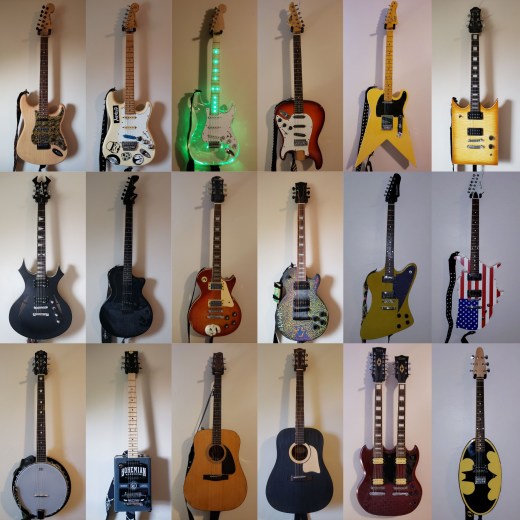
There are lots of shapes out there past the Stratocaster or Les Paul, whether it’s somewhat normal or custom insanity.  There’s the SG, the Telecaster, V’s (Flying, Jackson & more), hollowbodies like the Artcore or Gretsch models, the Explorer, the Ravelle, all the crazy B.C. Rich shapes, the Airline, even the Flycaster.  Are there really not enough guitar design shapes out there to satisfy you?  The Stratocaster doesn’t need to change shape, because there are plenty of other options out there!  I’m barely hitting the tip of the iceberg here.  I didn’t even touch on my B.B. Stone, FlipOut, or Batman axes.  How many distinct guitar shapes can you name in the comments?  (Actual produced shapes, not one-offs!)  Bonus for posting or linking to photos.

There’s also material.  Certainly guitars are mostly made of all types of wood, but there’s also plastic, graphite, Res-O-Glass (fiberglass), the Lucite / plexiglass / acrylic transparent guitars, aluminum necks, and so much more.

Once we get past the plethora of guitar makes, models, & shapes available… there are so many other innovations.  Some are great, some not-so great.  Just off the top of my head I can think of:  Synthesizer & MIDI Guitars, Fretlights, 7/8/12 strings, double neck guitars, the chord buddy, the Coral Sitar, built-in-wireless, the robot guitar, 3D printed guitars, Evertune… but none of them have really busted the mold (yet).  They’re all niche stuff.  This doesn’t even get into the many styles of bridges, tuners, tremolos, locks, and other parts that have been refined… or wiring.  You can get CRAZY with wiring.

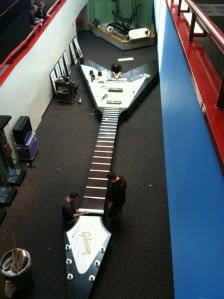
World's Largest Playable Guitar being set up at the Carnegie Science Center (Pittsburgh, PA)

World’s Largest Playable Guitar being set up at the Carnegie Science Center – Pittsburgh, PA (Photo Credit: Kara / @ohidontthinkso)

The traveling guitar exhibit is at the Carnegie Science Center in Pittsburgh right now.  I can’t wait to check it out.  It’s got the world’s largest playable guitar.  I was lucky enough to get a preview the other day via Twitter.  Tell me that’s not an innovation?  It will no doubt inspire many to pick up the guitar, or dust off the one they already have.  The entire exhibit displays guitars, how they work, their history, & all kinds of fun interaction.

So, next time you think that the guitar has become stagnant, I ask you to go get your hands one one of the many non Strat options above… or even a non-standard Strat option… like a Fat Strat, hot-rodded wiring, or a backwards one.  There are plenty of different, innovative, and goofy guitars out there.  Rock out on something original!