Food Allergy News, the good kind…


OK, so my last Food Allergy post was a little sad, disheartening, and rant-like.  Hopefully this one will be the Yang to the others Yin.  (Or is that Yin to the others Yang?)

I’d like to share some good news in the form of links, and a little commentary…

http://twitter.com/#!/AllergyEats/status/17239393752322048

http://twitter.com/#!/FoodAllergy/status/17567884217683969

  • FAAN | The Food Allergy & Anaphylaxis Management Act – Finally, the FAAMA bill has passed, and is expected to be signed into law.  This will hopefully prevent events like the ones surrounding Katelyn’s death from happening in the future by making sure schools are more educated on the subject, and more equipped to deal with similar situations.  Sadly, it’s a voluntary policy and not a mandatory one.

http://twitter.com/#!/AiXeLsyD13/status/17572685122895872

Food Allergy News, the Katelyn Carlson tragedy.


So food allergy news seems to be all over the place the last few weeks.  There are good things happening, and there are bad things happening.  I’ll hit you with the bad news first, then we can move on to the good news with a perspective on why it’s good news & why it’s important.  (Looks like I’m so long-winded, that will need to be its own blog post.)

Sadly, Katelyn Carlson, a 13 year old girl passed away earlier this month due to an anaphylactic reaction to peanut oil or a peanut cross-contaminant in some Chinese food that was served at a school function.  Apparently parents and teachers “checked multiple times” with the restaurant to make sure there were no peanuts in the food, or peanut oil… I’m guessing there were cross-contaminants somewhere along the line.  My thoughts on the subject are summed up perfectly in a Nut-Free Mom blog post on the subject.  While I don’t want to appear as pointing the finger at anyone… this tragedy could have certainly been avoided if the parents, teachers, administrators, and/or restaurant employees were all better educated about food allergies and cross-contamination.  Unfortunately, all involved will certainly be more cautious about such issues in the future.

Mr. Yuk
Mr. Yuk

Being allergic to shellfish, Asian food is at the top of my “No!/Keep Away!/Do Not Touch!” list.  (Okay, maybe 2nd to Red Lobster, Joe’s Crab Shack, & Long John Silver’s.) Not only is shellfish a visible ingredient in Asian cuisine… crab can be in “vegetarian” egg rolls as something is lost in translation, and oysters and brine shrimp are commonly used to make a plethora of sauces.  Similarly, peanuts and peanut oil are an essential ingredient to a bunch of Chinese food.  Why would one even attempt to assume it was safe?  Obviously, it’s just not a good idea.  I have ended up becoming pretty good at making a few Chinese dishes at home that I know are safe where I can read all of the bottles.  It may not be as good as the place run by actual Chinese people a few blocks over, but it’s also not going to potentially kill me.

Obviously, this points to a need for better food allergy education across the board…

  • For Restaurants: The chefs, the owners, the waiters and waitresses, the host or hostesses… anyone who can be asked in any situation where there’s food involved needs to be educated about potential food allergy dangers ans especially about cross-contamination.  Also, they should be required to have an epi pen or two in their first aid kit, without question.
  • For manufacturers/processing plants: I call “shenanigans” on the whole labeling process that puts the CYA warnings like “This (whatever) processed in a facility that also processes peanuts, tree nuts, shellfish, wheat, and belly button lint.”  The other day I saw packaged cheese that had the shellfish warning on it.  Where, why, and how would cheese ever need to or potentially come into contact with shellfish while it’s being made or processed?  Does Admiral Ackbar run your processing plant?  Is there lobster flavored cheese every few runs?  I would push for stricter rules for these companies where such allergens do not come into contact with other foods… it requires separation and sterilization.  Also… why not a “Mr. Yuk” type system with images or icons?  Everything else has been dumbed-down to icons over the years.  Why not make it easy with a rating-system for “contains”, “possibly contains”, and “processed in the same facility” with little pictographs of the scary deadly allergens?  Let’s differentiate between “allergy” and “intolerance” while we’re at it.
  • For schools: Food allergies are obviously a real issue.  Obviously there’s a comprehension problem when it comes to safety.  School nurse’s stations and cafeterias also ought to be required to be equipped with an epi pen.  This is one area where federal laws ought to trump state laws (as much as my inner political self is against this) and require them across the board, everywhere.  Teachers and administrators ought to be required to take food allergy classes or even tests just like first aid certification… or in with first aid certification.
  • For parents: Obviously, it’s a fine line between being over-protective and ridiculously worrisome and educating your child on food allergy and cross contamination issues.  They are serious and potentially life threatening.  Medical tags/bracelets and a personal epi pen are probably a good idea.  Your child needs to be equipped with the knowledge of potential allergy triggers, aware of what can happen, and the confidence to say “no, I’m not eating that” to other kids or ignorant adults.  In with being aware of what may happen… staying calm is necessary when an allergic reaction happens.  Knowledge of what happens, how, and how to stop it and get help can greatly increase the chances of remaining calm.
  • For people with food allergies: Obviously you’re (hopefully) on guard all the time.   Stay that way.  Read up on the subject, be informed, teach others.

So, there’s my humble and seemingly grumpy opinion.  My heart goes out to the family, friends, & classmates of Katelyn, I can’t imagine the greif that they’re going through.  I hope they can take some comfort in the fact that many others can use this tragedy to become more aware of and educate others on  food allergies, cross-contamination, and perhaps even funding for research for a cure.

AskCensus | A response on the ACS from the US Census Bureau:


So, out of all the people that I asked about the American Community Survey, none are so relevant as the U.S. Census Bureau itself.  After all, they’re the ones who put it out.  While PA State Rep. John Maher’s response is insightful and amusing, and the Spencarian’s Benjamin Kirby offers a different perspective… only the Census Bureau can comment officially.  It took me slightly longer than their professed 2-day response time to get back to me, but I’m sure they have better things to do than respond to some goofy idiot with pseudonym and an email account.  Also to be fair, they did kind of address my concerns on the FAQ.  I was just a little more long-winded about it.

Well, without further adieu, here’s what they had to say…

– ☞⌨☜ –

from: AskCensus <askcensus@custhelp.com>
reply-to: AskCensus <askcensus@custhelp.com>
to: recrat.demopublican@gmail.com
date: Thu, Oct 28, 2010
subject: The American Community Survey? [Incident: 000000-000000]

Recently you requested personal assistance from our on-line support center. Below is a summary of your request and our response.

If this issue is not resolved to your satisfaction, you may reopen it within the next 0 days.

Thank you for allowing us to be of service to you.

To access your question from our support site, click here.

Subject
The American Community Survey?
Discussion Thread
Response (ACSO – SLH) 10/28/2010 16:21
Thank you for using the US Census Bureau’s Question & Answer Center.  

We appreciate your feedback regarding the U.S. Census Bureau’s American Community Survey. You make many valid points and in a world free of people too busy to respond we could easily get by with one mailing. As it is, our research has shown better response results from multiple mailings and reminder cards and for this program using multiple mailings to get someone to respond to the paper questionnaire is cheaper than obtaining the information by phone or personal visit.

As for the Internet response option we are in the development and testing phase for this application. The Director of the Census Bureau, Dr. Groves, supports this project not only for the ACS but also for the 2020 Census.

As for reducing the time burden on the American public, the director is dedicating resources to researching adminstrative/alternative sources for the information collected on the ACS and Census forms.

If you need more information or have further questions about the ACS, please call our Customer Services Center on 1 (800) 923-8282.

Question Reference #000000-000000
Escalation Level: 16 hours from created
Category Level 1: American Community Survey
Date Created: 10/20/2010 10:49
Last Updated: 10/28/2010 16:21
Status: Solved PII (Admin)
Cc:

[—000:000000:00000—]

– ☞⌨☜ –

Well, that was certainly bland, but at least they are looking to technological advances in the future.  I still see this statement as crazy: “…for this program using multiple mailings to get someone to respond to the paper questionnaire is cheaper than obtaining the information by phone or personal visit.”  I’d love to see that on paper.  (Or better yet, in an email.)


The Spencarian’s Benjamin Kirby | Thoughts on the ACS…


So, you ready my letter to anyone who would listen about the American Community Survey, right?  Hopefully you’ve also read the amusing reply from PA State Rep. John Maher.  Now we have the thoughts of political blogger, Benjamin Kirby of The Spencerian.  Through the magic of Google I happened upon his blog, saw that he liked answering political questions, and (of course) asked my question(s).  I got an excellent reply…

from: Benjamin Kirby <bkirby816@yahoo.com>
to: Recrat Demopublican <recrat.demopublican@gmail.com>
date: Thu, Oct 21, 2010
subject: Re: A POLITICAL QUESTION: The American Community Survey?

Hey, great letter, Recrat!  Really good.

I’ll try to answer it on the blog — you’ll have to forgive me if I don’t re-post the whole thing.  I’ll try to do your general concept justice, though.

Just as a quick answer, let me say that I think you’ll see huge changes in things like the ACS as well as the ten-year census over the next five to ten years.  We have Facebook, Twitter, and who knows what else in the future.  There is almost no reason to cut down a forest to do the ACS.

That said, I know some people who rely on the data the ACS provides, and it.  Is.  Critical.  It’s really important stuff, and it’s so important that people fill it out, that they’ll do whatever it takes to get their attention.  There’s the old marketing adage: tell them what you’re going to tell them, tell them, then tell them what you’ve told them.  And the only way the government can do that efficiently right now is through snail mail and paper.  Sounds weird, I know — but it’s true.

We’ll explore this more in the post in the next few days.

Thanks so much.

BJK

…and it was followed-up by a blog post:

Q & A: Answering a Question with a Question

I won’t re-post the whole thing here, but I would urge you to check out his blog, and post your comments there or here.

An excerpt…

First of all, let’s be totally fair to Recrat: he asked a great question.  The only problem with it was that it was in the neighborhood of, oh, around 1,250 words.  The highlights he asked about involved wasted resources in producing the U.S. Census Bureau’s American Community Survey in the area of money, time, energy, and paper.

Ha ha.  Sorry for being wordy, but…

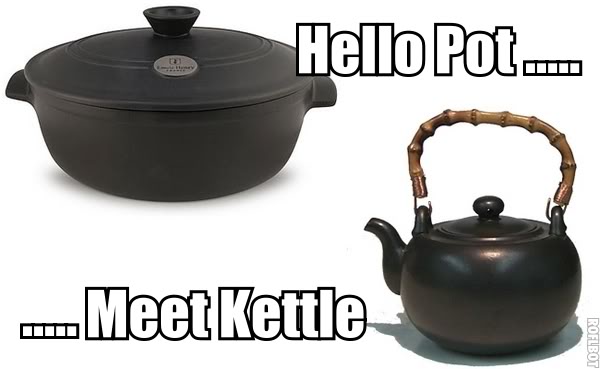
Hello Pot...  ...Meet Kettle.

I guess it’s in all of us blog people.